Quadratic_equation
Quadratic formula
A quadratic equation with real or complex coefficients has two, but not necessarily distinct, solutions, called roots, which may or may not be real, given by the quadratic formula:
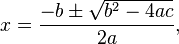
where the symbol "±" indicates that both

are solutions.
[edit] Discriminant
 0: 3⁄2x2+1⁄2x−4⁄3" src="http://upload.wikimedia.org/wikipedia/commons/thumb/e/e9/Quadratic_equation_discriminant.png/180px-Quadratic_equation_discriminant.png" class="thumbimage" border="0" height="180" width="180">
 ■ <0:>x2+1⁄2
■ =0: −4⁄3x2+4⁄3x−1⁄3
■ >0: 3⁄2x2+1⁄2x−4⁄3
In the above formula, the expression underneath the square root sign:

is called the discriminant of the quadratic equation.
A quadratic equation with real coefficients can have either one or two distinct real roots, or two distinct complex roots. In this case the discriminant determines the number and nature of the roots. There are three cases:
- If the discriminant is positive, there are two distinct roots, both of which are real numbers. For quadratic equations with integer coefficients, if the discriminant is a perfect square, then the roots are rational numbers—in other cases they may be quadratic irrationals.
- If the discriminant is zero, there is exactly one distinct root, and that root is a real number. Sometimes called a double root, its value is:
- If the discriminant is negative, there are no real roots. Rather, there are two distinct (non-real) complex roots, which are complex conjugates of each other:


Thus the roots are distinct if and only if the discriminant is non-zero, and the roots are real if and only if the discriminant is non-negative.
[edit] Geometry

f (x) = x2 − x − 2 = (x + 1)(x − 2) of a real variable x, the x-coordinates of the points where the graph intersects the x-axis, x = −1 and x = 2, are the roots of the quadratic equation: x2 − x − 2 = 0.
The roots of the quadratic equation

are also the zeros of the quadratic function:

since they are the values of x for which

If a, b, and c are real numbers and the domain of f is the set of real numbers, then the zeros of f are exactly the x-coordinates of the points where the graph touches the x-axis.
It follows from the above that, if the discriminant is positive, the graph touches the x-axis at two points, if zero, the graph touches at one point, and if negative, the graph does not touch the x-axis.
[edit] Examples
- 7x + 15 − 2x2 = 0 has a strictly positive discriminant Δ = 169 and therefore has two real solutions :
 and
and  .
. - x2 − 2x + 1 = 0 has a discriminant Δ whose value is zero, therefore it has a double solution

- x2 + 3x + 3 = 0 has no real solution because Δ = − 3 <>. But it has two complex solutions x1 and x2:
 and
and 
[edit] Quadratic factorization
The term

is a factor of the polynomial

if and only if r is a root of the quadratic equation

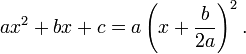
It follows from the quadratic formula that

In the special case where the quadratic has only one distinct root (i.e. the discriminant is zero), the quadratic polynomial can be factored as
posted by Nilesh at
October 02, 2008


0 Comments:
Post a Comment
Subscribe to Post Comments [Atom]
<< Home